
Skip to content
Greatest Appliances

Best Portable Generators

Six gasoline-powered portable generators, smallest to largest, compared on each maker's published specifications. Every pick shuts itself off automatically when carbon monoxide builds up; four also run on propane and one on natural gas.

  1. Top pickLightest pick for camping and small loads

    Honda EU2200i

    Model EU2200ITAN

    Who it's for
    For camping, tailgating or a short outage when you want a generator one person can lift into a car, and only a few things need power at once: lights, phones, a laptop, a fan or a small fridge.
    Why it's on the list
    At 47.4 lb it's the lightest generator here by more than half. Honda rates it at 1,800 running watts and up to 8.1 hours at a quarter load on a 0.95-gallon tank, and its CO-MINDER sensor shuts the engine off if carbon monoxide builds up around it.
    Main drawback
    1,800 running watts covers a few small loads, not a house: there's no 240 V outlet for a transfer switch and no 30-amp RV outlet, only one 20 A duplex. It runs on gasoline only, and Honda doesn't sell it in California.
    Running watts (gas)
    1,800 W
    Fuel
    Gasoline
    CO shutoff
    Yes: CO-MINDER
    Weight
    47.4 lb

    Research-based: maker specifications, a CPSC recall check and an exact-model listing check. Not hands-on tested.

  2. Pick 2Dual-fuel inverter with a 30-amp RV outlet

    Westinghouse iGen5000DFc

    Model iGen5000DFc

    Who it's for
    For a travel trailer or camper with a 30-amp plug, or for running a fridge, sump pump and lights through extension cords in an outage, on gasoline or a propane tank.
    Why it's on the list
    Westinghouse lists 3,900 running watts on gasoline and 3,500 on propane, a TT-30R RV outlet, electric and remote start, parallel capability and a CO sensor that shuts the generator down. It's rated for up to 18 hours at 25% load on a 3.4-gallon tank.
    Running watts (gas)
    3,900 W
    Fuel
    Gas or propane
    CO shutoff
    Yes: CO sensor
    RV outlet
    TT-30R (30 A)
    Main drawback
    It makes 120 V only, so it can't feed a 240 V transfer switch or a 240 V well pump. At 105.8 lb it rolls on wheels rather than being carried, and Westinghouse lists it as not CARB compliant.

    Research-based: maker specifications, a CPSC recall check and an exact-model listing check. Not hands-on tested.

  3. Pick 3Smallest pick with a 240 V transfer-switch outlet

    Champion 5500-Watt Dual Fuel (201505)

    Model 201505

    Who it's for
    For keeping essential circuits such as the fridge, freezer, sump pump and some lights running through a transfer switch or interlock, when you don't need an 8,000-watt generator.
    Why it's on the list
    Champion lists 5,500 running watts on gasoline and 5,000 on propane, a 120/240 V L14-30R locking outlet plus two GFCI household outlets, and CO Shield, which shuts the engine off when carbon monoxide builds up. It runs up to 11 hours at half load on a 7.7-gallon tank and is rated at 74 dBA from 23 feet.
    Running watts (gas)
    5,500 W
    Fuel
    Gas or propane
    CO shutoff
    Yes: CO Shield
    240 V outlet
    L14-30R (23 A)
    Main drawback
    Recoil start only, with no battery or electric start, and at 170 lb it moves on its wheel kit. Champion rates its L14-30R at 23 A, below the 30 A that plug type allows.

    Research-based: maker specifications, a CPSC recall check and an exact-model listing check. Not hands-on tested.

  4. Pick 4Gas-only home backup with 8,000 running watts

    Generac GP8000E

    Model G0077151

    Who it's for
    For running more of the house at once through a transfer switch or interlock, such as kitchen, furnace and sump pump circuits together, when you'd rather store just one fuel.
    Why it's on the list
    Generac lists 8,000 running and 10,000 starting watts, a 120/240 V 30 A L14-30R outlet and two 20 A GFCI duplex outlets, electric start with an included battery, an hour meter and COsense CO shutdown. It's rated for 15 hours at 25% load on a 7.9-gallon tank.
    Running watts (gas)
    8,000 W
    Fuel
    Gasoline
    CO shutoff
    Yes: COsense
    240 V outlet
    L14-30R (30 A)
    Main drawback
    Gasoline only, 198 lb, and Generac publishes no noise rating. A CPSC recall in April 2026 covers GP8000E model G0077150 in a limited serial range (fuel can leak at first fill); this listing is model G0077151, but check your model and serial number on Generac's recall page.

    Research-based: maker specifications, a CPSC recall check and an exact-model listing check. Not hands-on tested.
  5. Pick 5Quieter large inverter for home backup and 50-amp RVs

    Champion 11,000-Watt Dual Fuel Inverter (201417)

    Model 201417

    Who it's for
    For backing up whole circuits through a transfer switch when noise matters, such as close neighbors or running overnight, or for a 50-amp RV, on gasoline or propane.
    Why it's on the list
    Champion rates it at 64 dBA from 23 feet, 10 dBA below its 5,500-watt open-frame model above, with 9,000 running watts on gasoline (8,100 on propane), L14-30R and 14-50R outlets, electric start with a battery and CO Shield. It runs up to 15 hours at a quarter load on 6.08 gallons.
    Running watts (gas)
    9,000 W
    Fuel
    Gas or propane
    CO shutoff
    Yes: CO Shield
    Noise (maker, stated distance)
    64 dBA at 23 ft
    Main drawback
    At 205.1 lb it's heavy for an inverter and moves on 8-inch solid wheels. Champion rates the 14-50R at 37.5 A rather than 50 A, and lists EPA certification but no CARB certification.

    Research-based: maker specifications, a CPSC recall check and an exact-model listing check. Not hands-on tested.

  6. Pick 6Tri-fuel backup that can run on natural gas

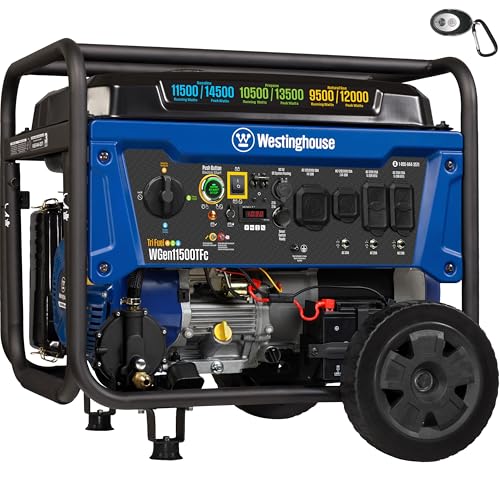
    Westinghouse WGen11500TFc

    Model WGen11500TFc

    Who it's for
    For a larger home or a long outage where you'd rather connect a natural-gas line or a large propane tank than keep refilling with gasoline, through a transfer switch.
    Why it's on the list
    Westinghouse lists 11,500 running watts on gasoline, 10,500 on propane and 9,500 on natural gas, L14-30R and 14-50R outlets, transfer-switch readiness, electric and remote start, and a CO sensor that shuts it down. It's rated for up to 19 hours at 25% load on a 9.5-gallon tank.
    Running watts (gas)
    11,500 W
    Fuel
    Gas, propane or natural gas
    CO shutoff
    Yes: CO sensor
    240 V outlet
    L14-30R + 14-50R
    Main drawback
    The heaviest pick at 230 lb. Westinghouse lists it as not CARB compliant and not RV ready, and it gives up 2,000 running watts on natural gas compared with gasoline.

    Research-based: maker specifications, a CPSC recall check and an exact-model listing check. Not hands-on tested.

Compare the picks

Figures come from each maker's product page or spec sheet; running watts are on gasoline. “Not published” means the maker gives no figure, or gives noise without a measuring distance. Each pick's main drawback is on its card above.

Side-by-side comparison of the picks in this guide
PickRunning watts (gas)FuelWeight
1,800 WGasoline47.4 lb
3,900 WGas or propane105.8 lb
5,500 WGas or propane170 lb
8,000 WGasoline198 lb
9,000 WGas or propane205.1 lb
11,500 WGas, propane or natural gas230 lb

What size generator do you need?

Running watts are what a generator can supply continuously; starting watts cover the few seconds a motor needs to get going.

  1. List what has to run at the same time in an outage or at camp, and note each item's running watts from its label or manual (volts × amps = watts).
  2. Add the running watts. That total must stay under the generator's running rating, because the starting figure is only a brief surge.
  3. Add the starting watts of the biggest motor that could switch on while everything else runs, such as a fridge compressor, sump pump or well pump. That sum must fit under the generator's starting rating.
  4. Decide how it connects: 120 V appliances on extension cords, or house circuits through a transfer switch, which needs a 240 V outlet such as an L14-30R.

Match a generator to the job

Jobs matched to the portable generators reviewed on this page
Lift it into a car by yourselfUnder 50 lb, per the makerQualifies: Honda EU2200i
Plug in a 30-amp travel trailer or camperA TT-30R outlet listed by the makerQualifies: Westinghouse iGen5000DFc
Plug in a 50-amp RVA 14-50R outlet the maker doesn't call unsuitable for RVsQualifies: Champion 11,000-Watt Dual Fuel Inverter (201417)
Feed a transfer switch or panel interlockA 120/240 V L14-30R outletQualifies: Champion 5500-Watt Dual Fuel (201505); Generac GP8000E; Champion 11,000-Watt Dual Fuel Inverter (201417); Westinghouse WGen11500TFc
Switch to a propane tankDual- or tri-fuel, per the makerQualifies: Westinghouse iGen5000DFc; Champion 5500-Watt Dual Fuel (201505); Champion 11,000-Watt Dual Fuel Inverter (201417); Westinghouse WGen11500TFc
Connect to a natural-gas lineTri-fuel, per the makerQualifies: Westinghouse WGen11500TFc
Know how loud it is before you buyNoise published with a measuring distanceQualifies: Champion 5500-Watt Dual Fuel (201505); Champion 11,000-Watt Dual Fuel Inverter (201417)

Each row lists only generators whose maker states the feature. Running watts drop on propane and natural gas: the makers' figures for each pick are in the detailed reviews below.

Sources:Generac: what surge (starting) wattage means

Inverter or conventional?

An inverter generator changes engine speed to match the load; a conventional open-frame generator runs at a fixed speed whatever you plug in. Champion's own figures show the difference at the same measuring distance: its 201417 inverter, with variable engine speed, is rated at 64 dBA from 23 feet, and its 201505 open-frame model, at a fixed 3,600 rpm, at 74 dBA.

Makers also quote total harmonic distortion, a measure of how clean the output is for electronics: Westinghouse lists 3% or less for its iGen5000DFc inverter and 5% or less for its open-frame WGen11500TFc.

On this list the inverters are the Honda EU2200i, Westinghouse iGen5000DFc and Champion 201417; the open-frame models are the Champion 201505, Generac GP8000E and Westinghouse WGen11500TFc.

Connecting a generator to your house

Never plug a generator into a wall outlet to power the house. The CPSC calls this backfeeding and warns against it, and the Department of Energy's Building America guidance says the home must be isolated from the grid to protect utility workers.

To run house circuits, have a licensed electrician design, permit and install the connection: either a manual transfer switch beside the main panel, wired to the circuits you choose, or an interlock on the main panel that lets the generator feed it only after the main utility breaker is off. Both use an outdoor connection box that the generator's cord plugs into.

That cord needs a 240 V outlet on the generator. The Champion 201505, Generac GP8000E, Champion 201417 and Westinghouse WGen11500TFc have an L14-30R (the two largest also have a 14-50R). The Honda and the Westinghouse iGen5000DFc are 120 V only: use them with heavy-duty outdoor extension cords run to individual appliances, as FEMA and the CPSC advise.

Sources:U.S. DOE Building America Solution Center: generators for backup powerFEMA: use generators safely at homeCPSC: portable generator safety alert

Carbon monoxide: where to run it

Placement

  • Run it outside only, at least 20 feet from the house, with the exhaust pointed away from windows, doors and vents (CPSC).
  • Never in a home, garage, basement or shed, even with doors and windows open, and not on a porch or in a carport (CPSC).
  • Champion's warnings say the same without a number: outside only, far away from windows, doors and vents, with the exhaust pointed away from people and buildings.
  • Install carbon monoxide alarms with battery power or battery backup inside, and test them (CPSC).

Automatic CO shutoff and recalls

  • Every pick here has a CO shutoff its maker describes: Honda CO-MINDER, Westinghouse CO sensor, Champion CO Shield and Generac COsense. The CPSC advises looking for one. Champion says its shutoff is not a substitute for an indoor CO alarm or for safe operation.
  • Generac GP8000E: CPSC recall 26-407 (April 2026) covers model G0077150 in a limited serial range, because fuel can leak from the carburetor at first fill. The listing linked here is model G0077151, which isn't on the recall list, and older GP8000E models recalled in 2021 for a handle hazard don't include it either. Check any unit on Generac's recall lookup.
  • On Nov 16, 2026 the CPSC recall database had no recall for the Westinghouse or Champion models here. Earlier Honda recalls covered EU2200i units sold from 2018 to early 2020, and a 2020 Westinghouse recall covered the older iGen4500DF; check the serial number of any older or used unit.

Sources:CPSC: winter storm safety tips (Dec 2025)CPSC: what to know about generators and COChampion: 201505 safety notes (CO Shield)CPSC recall database

Fuel storage and upkeep

  • Store gasoline outside living areas in labeled, non-glass safety containers, away from fuel-burning appliances such as a gas stove (CPSC, FEMA).
  • Turn the generator off and let it cool before refueling: fuel spilled on hot engine parts can ignite (CPSC, FEMA).
  • Start it and run it under load at least once a month, keep fresh fuel in the tank and use a fuel conditioner, so it's ready when the power goes out (Wisconsin DATCP).
  • Champion, Generac and Westinghouse list automatic low-oil shutdown on their models here. Follow the owner's manual for oil type and change intervals.

Sources:CPSC: portable generator safety alertFEMA: use generators safely at homeWisconsin DATCP: generator safety

Should you buy portable generators?

A good fit if you need

  • Keeping a fridge, sump pump, lights and phones going through an outage
  • Camping, tailgating and RV power away from a hookup
  • Running house circuits through a transfer switch or interlock an electrician has installed

Look elsewhere if you need

  • Running indoors, in a garage, basement or shed, or on a porch or in a carport
  • Plugging into a wall outlet to power the house
  • Automatic whole-house backup that starts on its own (that is a standby generator)

How these picks were chosen

Will Henschell approved the six picks and the reason given for each; every reason rests on the maker's published specifications, a CPSC recall check and an exact-model listing check. No brand pays to be included or ranked.

Research only. Every figure comes from the maker's product page or spec sheet, accessed 2026-11-16. Each ASIN was matched to its exact model on Amazon without the affiliate tag, and each model was checked against CPSC's recall database the same day. Two ASINs on the original list were not used: one listing contradicted itself and has no maker documentation, and one was a variant without a CO sensor, replaced by the version that has one. No product was tested hands-on.

Will Henschell

Researched and written by

What decided the ranking

  • Portable generators that run on gasoline: gas-only, dual-fuel (gasoline or propane) and tri-fuel (gasoline, propane or natural gas); no propane-only, natural-gas-only, diesel, battery power stations or standby units
  • Automatic carbon monoxide shutoff stated by the maker on every pick
  • A different job or size class for each pick: camping, a 30-amp RV, essentials backup, gas-only backup, a quieter large inverter, tri-fuel backup
  • Evidence: the maker's product page or spec sheet for every figure; noise only where the maker states a measuring distance, run time only at the maker's stated load
  • Exact model on Amazon matches the maker's model, checked without the affiliate tag; each model checked against CPSC's recall database

Sources reviewed

  • Manufacturer product pages and spec sheets
  • Amazon listings, checked for the exact model only
  • CPSC recall database and CPSC, FEMA and U.S. Department of Energy guidance

Testing status

Sourced research. Nothing on this page is presented as hands-on tested unless test notes are shown.

Read the full methodology

Spotted an error? Tell us. Will reads every message himself and corrects confirmed errors on the page.

The picks in detail

Pick 1Top pickLightest pick for camping and small loads

Honda EU2200i

By Honda, model EU2200ITAN. Full listing name: Honda EU2200i 2200-Watt Inverter Generator with CO-MINDER (EU2200ITAN)

Honda's EU2200i is a small enclosed inverter generator built around the GXR120 engine. Eco Throttle lets the engine slow down when the load is light, which is how Honda gets up to 8.1 hours from less than a gallon of gasoline. This listing is the current EU2200ITAN with CO-MINDER, which watches carbon monoxide levels around the generator and shuts it down, and with Honda's My Generator app for wireless stop and service reminders over Bluetooth.

Pros

  • 47.4 lb dry weight, the lightest here
  • CO-MINDER automatic carbon monoxide shutdown
  • Up to 8.1 hours at ¼ load on 0.95 gal, per Honda

Cons

  • 1,800 running watts and one 20 A duplex outlet
  • Gasoline only; not sold in California
Best for
Camping and tailgating; Lights, phones and small appliances in a short outage
Skip it if
You want to back up circuits through a transfer switch; You need a 30-amp RV outlet

Published specs

Type
Inverter
Running watts (gas)
1,800 W
Starting watts (gas)
2,200 W
Fuel
Gasoline
CO shutoff
Yes: CO-MINDER
240 V outlet
None (120 V only)
RV outlet
None
Weight
47.4 lb
Run time (maker's stated load)
8.1 h at ¼ load
Emissions
Not sold in California
Warranty
3 yr

Sources:Manufacturer specs checkedRetailer listing checkedSource reviewed

Pick 2Dual-fuel inverter with a 30-amp RV outlet

Westinghouse iGen5000DFc

By Westinghouse Outdoor Power Equipment, model iGen5000DFc. Full listing name: Westinghouse iGen5000DFc Dual Fuel Inverter Generator with CO Sensor

Westinghouse's iGen5000DFc is a wheeled, enclosed inverter that runs on gasoline or propane, and Westinghouse includes a propane regulator and hose. Its outlets are a 120 V duplex, two USB ports and a TT-30R for travel trailers, and it can run in parallel with a second Westinghouse inverter. The "c" in the model name is the CO sensor: Westinghouse lists none on the otherwise similar iGen5000DF.

Pros

  • TT-30R RV outlet and parallel capability
  • Gasoline or propane; propane hose included
  • Up to 18 h at 25% load on gasoline, per Westinghouse

Cons

  • 120 V only: no transfer-switch outlet
  • 105.8 lb; not CARB compliant
Best for
30-amp travel trailers and campers; Extension-cord backup for a fridge, sump pump and lights
Skip it if
You want to feed a 240 V transfer switch; You need to lift it into a vehicle alone

Published specs

Type
Inverter
Running watts (gas)
3,900 W
Starting watts (gas)
5,000 W
Fuel
Gas or propane
CO shutoff
Yes: CO sensor
240 V outlet
None (120 V only)
RV outlet
TT-30R (30 A)
Weight
105.8 lb
Run time (maker's stated load)
18 h at 25% load
Emissions
Not CARB compliant
Warranty
3 yr

Pick 3Smallest pick with a 240 V transfer-switch outlet

Champion 5500-Watt Dual Fuel (201505)

By Champion Power Equipment, model 201505. Full listing name: Champion 201505 5500-Watt Dual Fuel Portable Generator with CO Shield

Champion's 201505 is an open-frame dual-fuel generator with a 389 cc engine that runs at a fixed 3,600 rpm. Its covered outlet panel has the 120/240 V L14-30R that a transfer-switch or interlock cord plugs into, plus two GFCI household duplexes, and Champion's Intelligauge display. A 6.5-foot propane hose with a built-in regulator and a wheel kit come with it.

Pros

  • 120/240 V L14-30R plus two GFCI household outlets
  • CO Shield automatic shutoff
  • 74 dBA from 23 ft; up to 11 h at ½ load on gasoline

Cons

  • Recoil start only
  • 170 lb; L14-30R rated 23 A
Best for
Essential circuits through a transfer switch or interlock; A first home-backup generator on gas or propane
Skip it if
You want push-button or remote start; You want to run most of the house at once

Published specs

Type
Conventional (open frame)
Running watts (gas)
5,500 W
Starting watts (gas)
6,875 W
Fuel
Gas or propane
CO shutoff
Yes: CO Shield
240 V outlet
L14-30R (23 A)
RV outlet
None
Weight
170 lb
Run time (maker's stated load)
11 h at ½ load
Noise (maker, stated distance)
74 dBA at 23 ft
Emissions
EPA certified; CARB not listed
Warranty
3 yr

Sources:Manufacturer specs checkedRetailer listing checkedSource reviewed

Pick 4Gas-only home backup with 8,000 running watts

Generac GP8000E

By Generac, model G0077151. Full listing name: Generac GP8000E 8,000-Watt Portable Gas Generator with COsense (G0077151)

Generac's GP8000E is a gasoline-only open-frame generator with a 420 cc OHV engine and a 7.9-gallon tank with a fuel gauge. Electric start runs off an included 12 V battery, with a recoil pull as backup; an hour meter tracks maintenance; and COsense lights a red hazard lamp and shuts the engine down when carbon monoxide builds up. Generac lists it as compatible with its HomeLink manual transfer switches.

Pros

  • 10,000 starting watts for motor loads
  • L14-30R (30 A) plus two 20 A GFCI duplexes
  • 15 h at 25% load on 7.9 gal, per Generac

Cons

  • Gasoline only
  • 198 lb; no published noise rating
Best for
Transfer-switch backup with one fuel to store; Circuits with motors that need a big starting surge
Skip it if
You want propane as a backup fuel; You want a published noise rating

Published specs

Type
Conventional (open frame)
Running watts (gas)
8,000 W
Starting watts (gas)
10,000 W
Fuel
Gasoline
CO shutoff
Yes: COsense
240 V outlet
L14-30R (30 A)
RV outlet
None
Weight
198 lb
Run time (maker's stated load)
15 h at 25% load
Emissions
49-state (CSA)
Warranty
3 yr

Pick 5Quieter large inverter for home backup and 50-amp RVs

Champion 11,000-Watt Dual Fuel Inverter (201417)

By Champion Power Equipment, model 201417. Full listing name: Champion 201417 11,000-Watt Dual Fuel Inverter Generator with CO Shield

Champion's 201417 is an enclosed dual-fuel inverter on a 459 cc engine whose speed follows the load (Champion lists engine speed as variable). It has an L14-30R and a 14-50R for 240 V transfer-switch and RV cords, two GFCI duplexes and a regulated 12 V outlet, plus electric start with an included battery and Champion's Intelligauge with Power Meter.

Pros

  • 64 dBA from 23 ft, per Champion
  • L14-30R and 14-50R plus two GFCI duplexes
  • 9,000 running watts on gasoline, 8,100 on propane

Cons

  • 205.1 lb on solid wheels
  • 14-50R rated 37.5 A; no CARB certification listed
Best for
Quieter whole-circuit home backup; 50-amp RVs
Skip it if
You need to lift it; You need a CARB-listed generator

Published specs

Type
Inverter
Running watts (gas)
9,000 W
Starting watts (gas)
11,000 W
Fuel
Gas or propane
CO shutoff
Yes: CO Shield
240 V outlet
L14-30R + 14-50R
RV outlet
14-50R (37.5 A)
Weight
205.1 lb
Run time (maker's stated load)
15 h at ¼ load
Noise (maker, stated distance)
64 dBA at 23 ft
Emissions
EPA certified; CARB not listed
Warranty
3 yr

Sources:Manufacturer specs checkedRetailer listing checkedSource reviewed

Pick 6Tri-fuel backup that can run on natural gas

Westinghouse WGen11500TFc

By Westinghouse Outdoor Power Equipment, model WGen11500TFc. Full listing name: Westinghouse WGen11500TFc Tri-Fuel Portable Generator with CO Sensor

Westinghouse's WGen11500TFc is the largest pick: an open-frame generator on a 550 cc engine that runs on gasoline, propane or natural gas. Westinghouse lists it as transfer switch ready, ST switch ready and compatible with its WATS200 automatic transfer switch, and includes a propane regulator and hose, a battery charger and a remote key fob.

Pros

  • Gasoline, propane or natural gas
  • L14-30R and 14-50R; transfer switch ready
  • Up to 19 h at 25% load on 9.5 gal, per Westinghouse

Cons

  • 230 lb, the heaviest here
  • Not CARB compliant or RV ready, per Westinghouse
Best for
Long outages with a natural-gas or large propane supply; Larger homes backed up through a transfer switch
Skip it if
You want something easy to move; RV use

Published specs

Type
Conventional (open frame)
Running watts (gas)
11,500 W
Starting watts (gas)
14,500 W
Fuel
Gas, propane or natural gas
CO shutoff
Yes: CO sensor
240 V outlet
L14-30R + 14-50R
RV outlet
None (not RV ready)
Weight
230 lb
Run time (maker's stated load)
19 h at 25% load
Emissions
Not CARB compliant
Warranty
3 yr

Sources:Manufacturer specs checkedRetailer listing checkedSource reviewed

Portable generators: questions

What size portable generator do I need for my house?

Add up the running watts of everything you want on at the same time, then add the starting watts of the largest motor (a fridge, sump pump or well pump) that might start while the rest are running. That total has to fit under the generator's starting rating, and the running total under its running rating. The watts are on each appliance's label or in its manual. On this list, the 5,500-watt Champion is the smallest generator with a 240 V outlet for a transfer switch; the 8,000- to 11,500-watt picks run more circuits at once.

How far should a generator be from the house?

The CPSC says to run a portable generator outside only, at least 20 feet from the house, with the exhaust pointed away from windows, doors and vents, and never in a garage, basement, shed, porch or carport, even with doors open. The makers' own warnings say outside only and far away from windows, doors and vents. Put carbon monoxide alarms with battery power or battery backup inside the house.

Is a generator with CO shutoff safe to run in a garage?

No. Champion says its CO Shield is not a substitute for an indoor carbon monoxide alarm or for safe operation, and the CPSC says never to run a generator inside a home or garage, even with doors and windows open. Automatic shutoff is a backstop for a generator that is already outside and far from the house.

Can I plug a portable generator into a wall outlet to power my house?

No. The CPSC warns against this, which is called backfeeding: power can flow back into the utility lines and endanger line workers. To run house circuits, have a licensed electrician install a transfer switch or a panel interlock with a generator inlet, and connect a generator with a 240 V outlet such as an L14-30R. The 120 V-only picks here power appliances through heavy-duty outdoor extension cords instead.

Inverter or conventional generator: which do I need?

An inverter changes engine speed with the load; a conventional open-frame generator runs at a fixed speed. Champion lists its 201417 inverter's engine speed as variable and its 201505 open-frame model at 3,600 rpm, and rates them at 64 and 74 dBA from 23 feet. Westinghouse lists total harmonic distortion of 3% or less for its iGen5000DFc inverter and 5% or less for its open-frame WGen11500TFc. If noise or electronics matter, as at a campsite, in an RV or with neighbors close by, look at the inverters; for the most watts on a transfer switch, the open-frame picks here cover 5,500 to 11,500 running watts.

Should I get a dual-fuel generator or a gas-only one?

Dual fuel lets you switch to a propane tank when gasoline is hard to get, at a cost in output: on the makers' figures the Westinghouse iGen5000DFc drops from 3,900 to 3,500 running watts on propane, the Champion 201505 from 5,500 to 5,000 and the Champion 201417 from 9,000 to 8,100. The tri-fuel WGen11500TFc also runs on natural gas at 9,500 watts. Gas-only models such as the Generac GP8000E and Honda EU2200i keep one fuel to store and manage.

How long will a portable generator run on a tank?

It depends on the load, so compare run times at the load the maker states. Generac rates the GP8000E at 15 hours at 25% load but 10 hours at 50% load on its 7.9-gallon tank. The others here: Honda EU2200i 8.1 hours at a quarter load, Westinghouse iGen5000DFc 18 hours and WGen11500TFc 19 hours at 25% load, Champion 201417 15 hours at a quarter load, and Champion 201505 11 hours at half load.